ISO/IEC 17025 · AS/NZS 3760 · AS 2193
Calibration management software, automated.
One system for calibration laboratories and inspection businesses — including Electrical Test & Tag (AS/NZS 3760) — built to ISO/IEC 17025 from the first line, with inspection done properly and never mislabelled as calibration.
18
Calibration and inspection fields
86
Instrument types, each with a pinned template
13
Quality registers kept as you work
8
Roles, enforced by the database over 29 permissions
Bench · torque wrench · AS 2193
illustration
Computed result
Computing…
Uncertainty (k=2)
—
An illustration of the bench sheet. The real engine grades every point three ways and names which one limited it.
Customer portal · included on every plan
Your customers sign in to their own certificates.
Each customer sees the instruments you look after for them, what falls due, and every certificate and inspection report you have issued them — downloadable at any hour, without a phone call. You decide what is shown, and portal logins are never charged for.
Setup · Customer portal
illustration · try the switches
You decide
What they see
database: the rows are refused to the customer's session, not just left off the page. screen: a column or a button.
Your customer sees
Meridian Electrical Works
Your laboratory · your logo, your colour
Out of calibration
1
Due within 30 days
1
With the laboratory
2open jobs
Quotes to decide
1
Invoices unpaid
1
PayComing due
| Instrument | Serial | Due |
|---|---|---|
| Clamp meter 600 A | CM-3318 | 3 days over |
| RCD tester | RC-2201 | 20 Nov |
Certificates and reports
| Number | Next due | |
|---|---|---|
| MEW-0001-2 | 2 Oct 2027 | Download · Verify |
| MEW-0007-1 | 14 Aug 2027 | Download · Verify |
Signs in with a one-time code emailed to any contact or accounts address you hold for them. No password.
Fewer “can you send the certificate” calls
Every certificate and inspection report you have issued them, current and amended, to download and verify themselves — the night before their audit included.
They see what is due before you chase
What is overdue and what falls due within 30 days is on their overview, and your monthly recall email links straight to it. They can ask you for a quote from the same place.
Your name on the door
Your logo, name and colour on the portal, and a sign-in page of its own to send customers to. A one-time emailed code instead of a password, and each customer sees only its own company — the database enforces it.
Calibration and inspection
Calibration and Test & Tag. One laboratory system.
Manage calibration certificates, electrical inspection reports, customers, equipment, scheduling and recalls together — without running two separate software platforms.
Calibration certificate
ISO/IEC 17025- Each result with its measurement uncertainty
- Traceable to a named reference standard and its certificate
- Your declared decision rule wherever pass or fail is stated
- Issued only by a signatory competent for the method
Electrical inspection report
AS/NZS 3760- Pass or fail against the standard's criteria, item by item
- Hundreds of items in a batch grid, next-test-due tags at the point of test
- No grade and no uncertainty, because inspection is not calibration
- Never an accreditation mark it has not earned
Shared by both
- One customer register
- One equipment register
- One schedule and recall
- One invoice
- One customer portal
Inspection fields supported today: Test and tag, Electrical safety equipment, Lifting and height safety and Medical equipment safety testing. A mixed delivery goes on one job, and the document follows the item. For businesses that do both →
See it working
The screens a laboratory and its customers use.
Real pages from the demonstration laboratory, Southbank Calibration, which does not exist. Each links to the page that explains it.
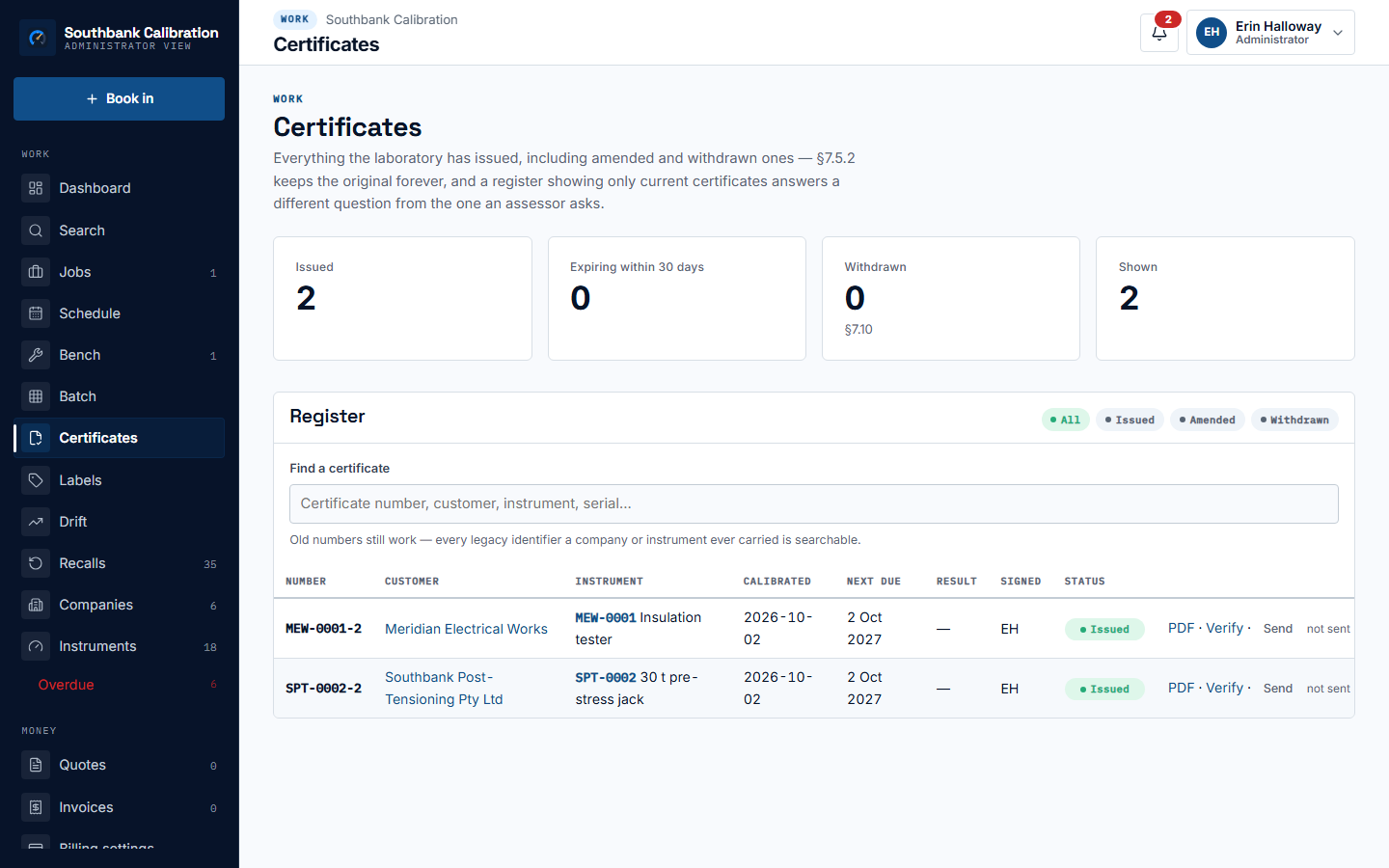
Certificates →
Computed, recomputed at issue, immutable, verifiable by QR code.
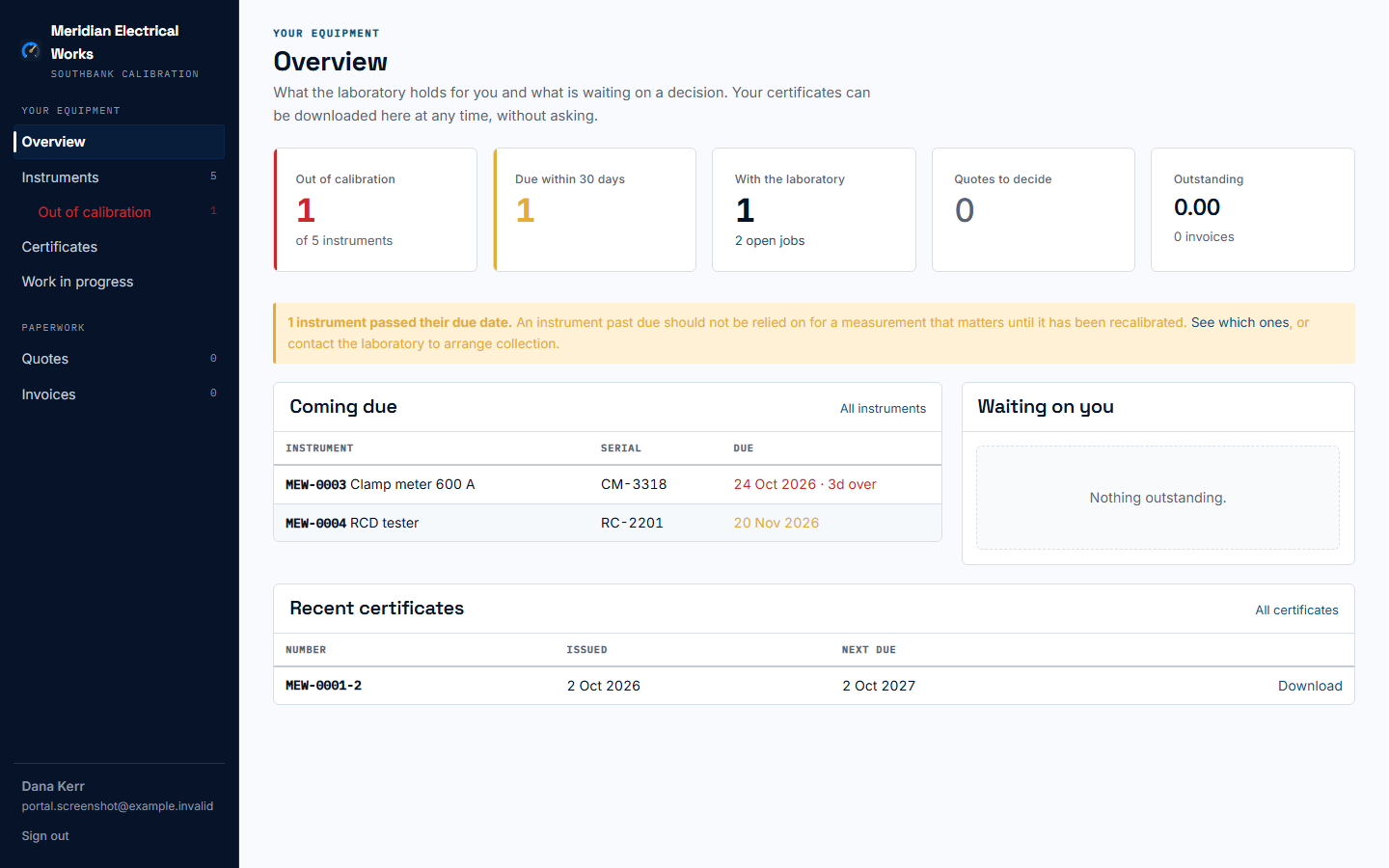
Customer portal →
Customers download their own certificates and see what is due. Free logins.
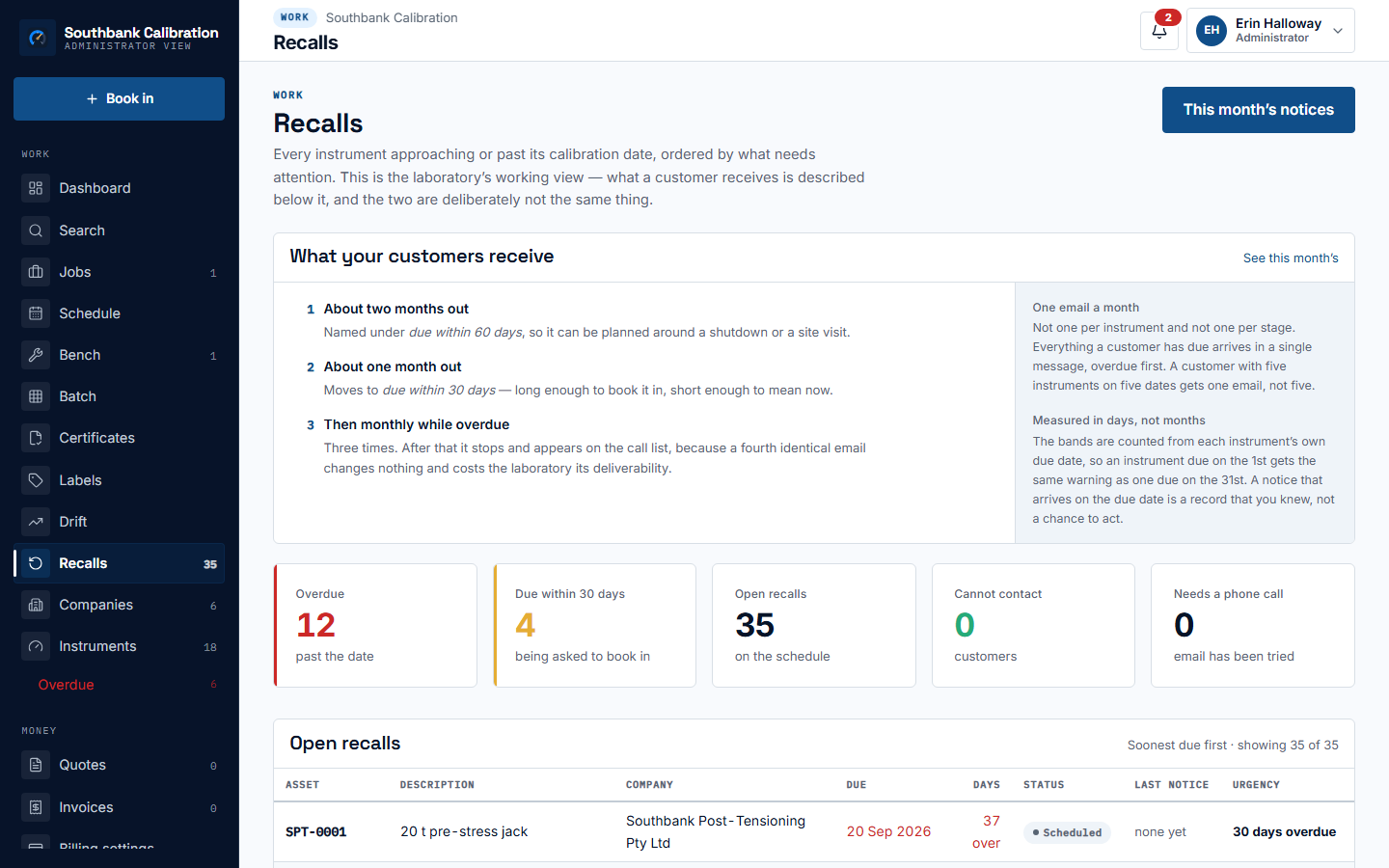
Recall →
One email a month per customer, then a call list. Next year's work books itself.
What CalibraWorks is
The metrology and the money are the same system.
A multi-tenant platform for calibration laboratories and inspection businesses, covering the whole lifecycle of a job — and carrying the ISO/IEC 17025 quality system around all of it as a by-product of doing the work.
It is not a LIMS bolted to an accounts package. Because the certificate and the invoice live in one place, a certificated item cannot be forgotten at invoicing, and an invoice cannot cite a certificate that does not exist.
Calibration of the appliance tester itself is metrology, and that is 17025 work. Testing and tagging the appliances is inspection. One system does both, and never prints one as the other.
Seven stages
Enquiry to recall, without leaving the system.
Quote, intake, bench or batch, calculation, document, invoice, payment, recall. Each stage hands the next one everything it needs.
01
Intake
One job per delivery. Condition on arrival recorded with photos. Labels print automatically.
02
Bench or batch
Bench: one instrument in depth. Batch: hundreds of items in a grid — Test & Tag, lifting gear, medical safety.
03
Calculation
Deterministic engine. Uncertainty, grade, decision rule, reproducibility — decimal arithmetic, versioned.
04
Certificate or report
Recomputed at issue. Refused on mismatch. Immutable. QR-verifiable, forever.
05
Invoice
Drafted from certificated items. Correct GST logic. Certificate numbers attached.
06
Payment
Card, PayID, bank transfer. Automatic reconciliation suggestions.
07
Recall
One email a month to each customer, listing what is overdue and what falls due. It protects the revenue you already earned.
08
And around it all
Thirteen quality registers, competence records, and an assessment pack assembled from the laboratory's own evidence.
18 fields
The system reshapes itself to the work you actually do.
14 calibration fields and 4 inspection fields. Choosing a field never restricts you — a dimensional lab can calibrate a torque wrench; a force lab can inspect lifting gear.
Calibration · 14 fields
Inspection · 4 fields
Inspection gets its own document type, its own batch grid, one-sided limits and next-test-due tags — and never an accreditation mark it has not earned.
Automation
It runs the work even when nobody is watching.
Eight background engines keep the register current, the standards in date, the certificates rendered and the invoices chased.
AI boundaries
AI assists intake. Nothing else.
- Deterministic reader first, AI reader second
- Seven accepted keys; forbidden keys dropped
- No AI in results, uncertainty, grading or decision rules
- Bedrock-ready, region-pinned to Sydney
A certificate computed to a lesser standard would be a different certificate, and there is no honest way to sell that.
Your own systems
A read-only API.
Instruments, certificates, jobs and invoices, read by keys you issue, scope and revoke, against a public OpenAPI description. It reads and never writes, so nothing reaches a certificate except through your own screens. An add-on — see pricing.
Verification
Verification never stops.
QR code and random token. Amendments and withdrawals are shown honestly. The person scanning the code is not our customer and never agreed to anything — so verification is never gated by a subscription.
Multi-site
One register, many sites.
Multiple locations and teams, 8 roles over 29 permissions, cross-site workflows, and row-level security enforced everywhere.
Where to go next
Start with the page written for your laboratory.
Three kinds of laboratory arrive here. Each has a page that names its situation first and the mechanism second — and three free tools that run the certificate engine itself.
Working towards NATA accreditation
On spreadsheets, an assessment ahead, and the evidence not yet in existence. The page most people should read first.
Accredited, still on spreadsheets
Reference standard quarantine, reverse traceability and the recall ladder, before the next cycle asks.
Calibration and Test & Tag together
One system that keeps an inspection report and a calibration certificate apart, on the same invoice.
Uncertainty budget calculator
GUM contributions, Welch–Satterthwaite, coverage factor. The engine a certificate uses, in your browser.
Decision rules and guard banding
Simple acceptance or a guard band per ILAC-G8, and what the acceptance limits become.
Data ownership
Export at any time, readable after cancellation, verification never gated, and what happens if we stop.
Also: the customer portal, the guides — uncertainty budgets, decision rules, AS 2193 grading, certificate contents and accreditation readiness — security and residency, the test uncertainty ratio, and how the options compare.
Start with what you need. Grow at your own pace. Keep your laboratory running on CalibraWorks.
Start free for 30 days, with no card and everything included. Nothing is deleted when a trial ends — the records are yours and stay readable and exportable.