Certificates · ISO/IEC 17025 §7.8
Certificates that are computed, not typed, and prove themselves
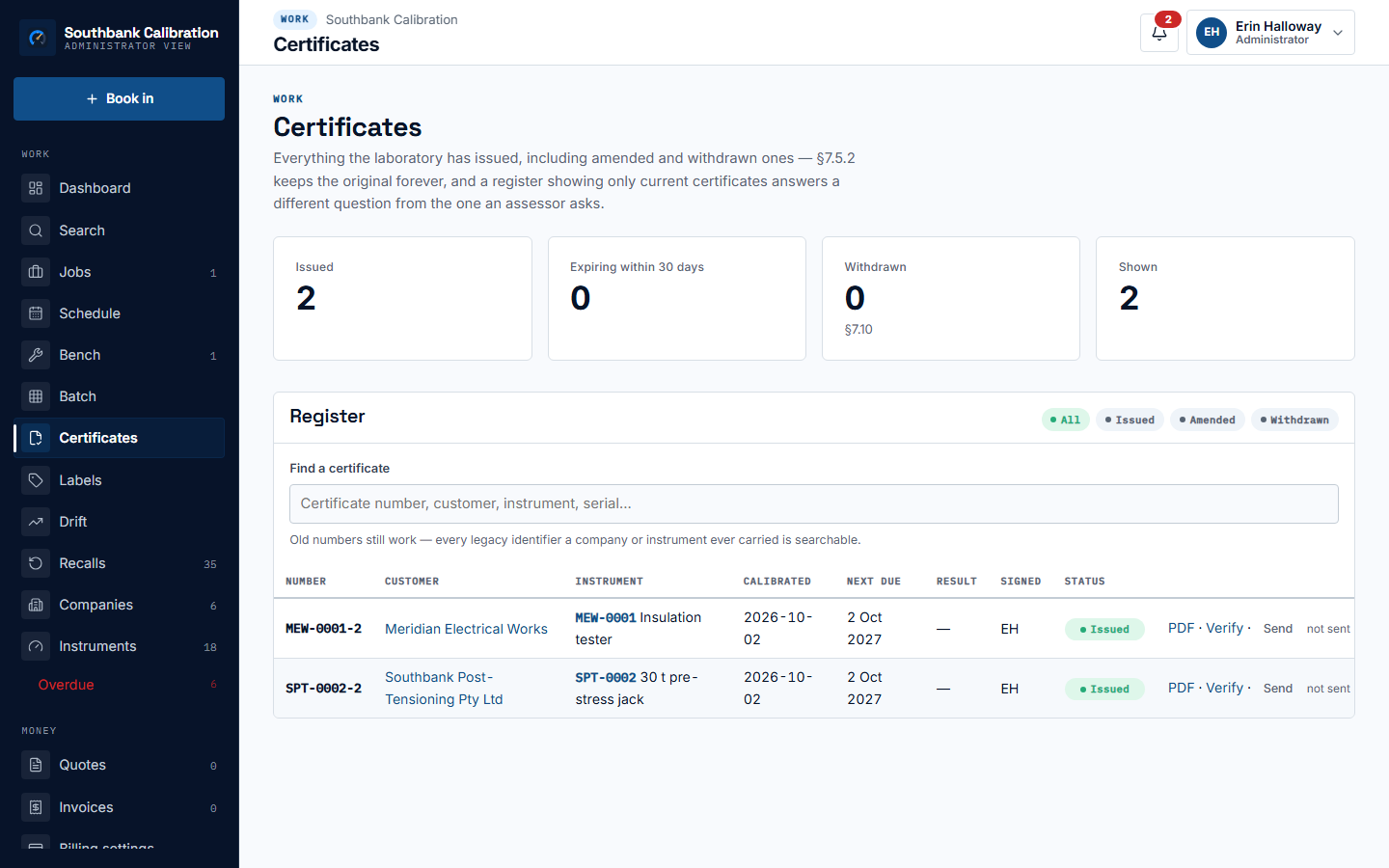
From readings to document
Five things happen at issue, and a person does one of them.
The signatory decides to issue. Everything else is the software refusing to let a certificate say something the readings do not.
Recompute, and refuse on a mismatch
The engine re-runs the calculation from the stored raw readings through the template version the sheet was filled under. If the result differs from the draft the reviewer approved, issue is refused and the event is logged. That is ISO/IEC 17025 §7.11.2 as a mechanism rather than a dossier.
Check the signatory and the master
Only a person holding a current authorised-signatory competence record for that method can issue (ISO/IEC 17025 §6.2.6), and the reference standard cited must have been in calibration on the day (ISO/IEC 17025 §6.4.6). Both are refused by the database, not by a warning.
Render the same bytes every time
The PDF is drawn without a browser, with an embedded font and a fixed creation date, so a reprint in three years produces the identical file and the recorded SHA-256 still matches. A hash that could drift would be decoration.
Store it where nothing can overwrite it
The file goes to a bucket that permits no overwriting; the record refuses deletion. A wrong certificate is corrected by an amendment: a new revision under the same number, the reason printed, the original kept, and the old verification link now saying so (ISO/IEC 17025 §7.8.8).
Send it, and let anybody verify it
Emailed to the customer on issue or by hand, under the laboratory's own letterhead and, where configured, through its own mail server. The QR code on the certificate and on the label opens a public verification page: issued by whom, when, due when, amended or withdrawn. No login, random token, never switched off.
Open a sample certificate (PDF), rendered by the engine for a laboratory that does not exist.
What the certificate carries
Every item ISO/IEC 17025 §7.8.2 and ISO/IEC 17025 §7.8.4 require: the laboratory and where the work was done, the customer, the instrument with its serial and condition on receipt, the method and version, the dates, each result with its uncertainty in the same unit, the reference standard with its own certificate number, the decision rule wherever a pass or fail is stated, the authorised signatory, and page n of N. The certificate requirements guide walks through the clauses.
Two document kinds, kept apart
A calibration certificate states what an instrument reads against a reference, with uncertainty and, for force, an AS 2193 class. An inspection report states that an item met a standard's criteria, carries no grade, and never an accreditation mark. The document follows the item, so a torque wrench and a box of insulating gloves on the same job get the right document each, on one invoice.
CalibraWorks certificates are computed by a deterministic engine, recomputed at issue and refused on mismatch, rendered byte-identically with their hash recorded, immutable once issued, amended only by a new revision, and verifiable by anybody through a QR code with no login.
Questions about certificates
- Can we use our own certificate layout?
- The wording, format, logo, accent colour, footer and signature image are the laboratory's to set, and a sample is rendered with the real engine before anything is saved. What cannot be switched off is anything ISO/IEC 17025 §7.8.2 requires a report to carry: the laboratory, the customer, the instrument, the method, the results with uncertainty, the decision rule, who signed, and page n of N.
- What stops somebody editing an issued certificate?
- The database. An issued certificate's file is written to storage that permits no overwrite, its SHA-256 is recorded, and the record refuses deletion. A correction is an amendment: a new revision under the same number with the reason stated, and the original kept for ever (§7.8.8). Nobody, including an administrator, can edit one.
- What does the QR code do?
- It opens a public page that confirms the certificate exists, which laboratory issued it, when it is due, and whether it has been amended or withdrawn. The token is random, never sequential, so nobody can enumerate a laboratory's certificates. It needs no login and is never switched off.
- Does it produce inspection reports too?
- Yes, and keeps them apart. An item under test and tag, lifting gear or medical safety gets an inspection report that states pass or fail against the standard's criteria, carries no uncertainty or grade, and never an accreditation mark, because inspection is a separate scheme (ISO/IEC 17020). The document follows the item, so both kinds can sit on one job and one invoice.
Start free. Thirty days, everything included.
No card, and one trial per organisation. Nothing is deleted when a trial ends — the records are yours and stay readable and exportable.